
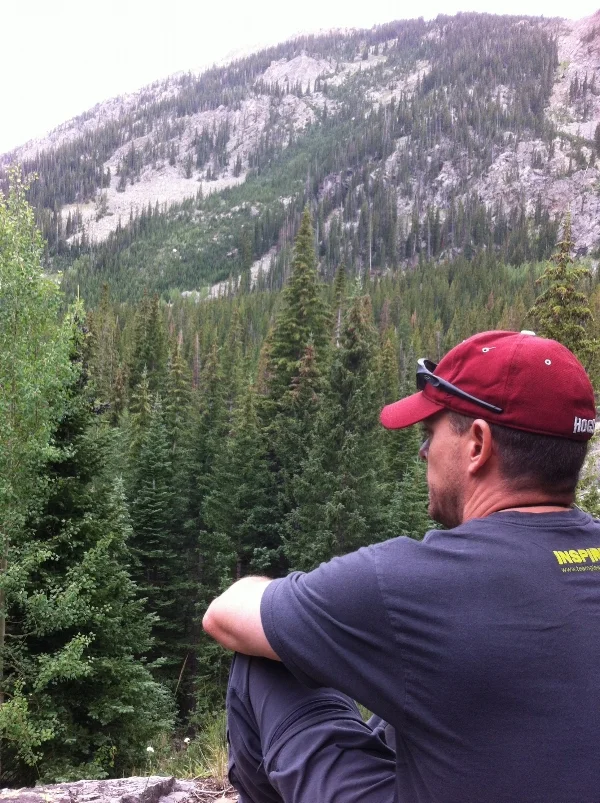
About Jason Fazio
I have spent most of my life trying to understand how things work.
Sometimes that meant turning wrenches on F-16s. Sometimes it meant engineering, satellites, or figuring out why a photograph didn't look the way I imagined it would. These days, it might mean identifying a wildflower, studying the geology of a place I'm photographing, rebuilding something on a thirty-year-old Japanese van, or standing outside before sunrise wondering what Mother Nature is going to do next.
Curiosity has been the constant.
We Are Our Experiences
I zipped through Florida, Turkey, Las Vegas, and Hawaii before my family settled in a small Arkansas town when I was in the third grade. The outdoors was always there.
One of my earliest memories of really noticing the natural world came while deer hunting. I remember sitting against a tree as the sun rose and watching the woods wake around me. Wildlife began moving. The light changed. Everything slowly came alive.
I remember wishing I had a camera instead of a gun.
It would take more than twenty-five years for that kid to finally get serious about one.
Before that happened, I left Arkansas with my young wife and a goal of getting an education. The path wasn't particularly direct.
I enlisted in the United States Air Force and became an F-16 mechanic. Those years took me to Arizona, South Korea, and eventually back to Arizona, where I became an F-16 maintenance instructor. Somewhere along the way, the Air Force sent me back to Arkansas to attend the University of Arkansas.
Fourteen years after leaving that small Arkansas town, I finally had my Bachelor of Science degree in Mechanical Engineering in hand.
WPS.
After graduation, I commissioned as an Air Force officer and joined the Air Force Research Laboratory in Ohio. That gave me several more years of hands-on engineering and problem-solving before I spent some time in the contracting world and eventually found my way into military space operations.
I finished my Air Force career flying GPS satellites.
I was also an instructor and evaluator, roles that probably had more influence on what I do today than I understood at the time.
I retired from the Air Force in 2020.
Then Came the Camera
I began getting serious about photography around 2017.
At first, photography was simply another hobby and another reason to be outside. I wanted a way to bring my adventures home with me. My family wasn't joining me on many of the hikes, backpacking trips, or ridiculous excursions I found myself taking, and photographs gave me a way to show them what I had seen.
But there was something else.
I still loved sitting quietly somewhere before sunrise and watching the world begin its day.
Photography gave me a reason to do more of that.
I've now spent roughly a decade fiddling with cameras, chasing light, making mistakes, solving problems, learning techniques, and collecting experiences.
There have been contests, publications, print sales, calendars, and other milestones along the way. I'm proud of them.
But they aren't the accomplishments I think about most.
The photographs themselves have become triggers for memories. I can look at an image years later and remember the cold, the wind, the hike, the person standing beside me, the drive that got me there, or the few minutes when the light did something that will never happen in exactly the same way again.
We only get one trip through this.
I believe we are our experiences.
Photography helps me remember mine.
The Five Billion Star Hotel
Eventually, all that traveling created another problem to solve.
Hotels didn't fit the way I wanted to photograph. I didn't want to drive to a hotel after an evening shoot, sleep for a few hours, then drive back into the mountains before sunrise. I wanted something small enough to go almost anywhere, capable enough to leave pavement behind, and large enough to serve as a hotel, kitchen, office, and photography base camp.
The U.S. market wasn't giving me what I wanted.
Japan did.
I found a mid-1990s Mitsubishi Delica L300 4x4 van and eventually turned it into what I call the Five Billion Star Hotel.
The Delica has become my photography partner and an ongoing engineering project.
It has solar power, an electric refrigerator, a computer, a sliding workspace, sleeping space, independent charging for my camera equipment, and a project list that somehow grows faster than I can complete it.
That's mostly my fault.
Every road trip creates another idea.
Fifty miles down a washboard road in Utah might become a tire-airing project. A cold morning creates another problem to solve. A week living out of the van inevitably ends with notes about what I could redesign, relocate, improve, or build next.
Trips create projects.
Projects create more trips.
It works out nicely.
Things Changed
For years, I thought very little of putting a backpack on and traveling twenty miles into the middle of nowhere.
That changed dramatically in 2023.
A medical emergency and its complications left me without a stomach, with significant abdominal damage, multiple hernias, and a body that processes food and energy very differently than it once did. I lost roughly one-third of my body weight.
One of those hernias currently allows my intestines to push upward into my chest, affecting my heart and lungs. Eating can be painful. Energy is a constant calculation. Camera equipment that once felt reasonably light now represents a much larger percentage of my body weight.
Twenty miles into the wilderness doesn't sound quite the way it used to.
That doesn't mean I've stopped going.
I've returned to the Delica after a long day of photography, eaten, fallen asleep at two in the afternoon, and awakened sixteen hours later just in time to photograph another sunrise.
Road trips tend to leave me pretty beat these days.
I still take them.
I don't know what my physical abilities will look like years from now, and another major surgery remains part of that equation. That uncertainty has probably made me more aware of something I already believed:
If there is something worth experiencing, I would rather go experience it while I can.
Photography, Planning, and a Little Luck
Landscape photography has taken me places I probably never would have visited otherwise.
I've watched Colorado's autumn aspens collide with the first snows of winter. I've wandered through the badlands of New Mexico, photographed Arizona's Superstition Mountains, explored the rocks and deserts of Utah, stood beside Oregon waterfalls, experienced Washington's rainforests, watched wildlife in Wyoming, and traveled through a California landscape that sometimes seems determined to contain every type of scenery available on the continent.
I've experienced some of my hottest and coldest days standing behind a camera.
I wouldn't trade them.
Over time, photography has also changed the way I look at a landscape.
I used to spend much more time walking around hoping to find inspiration. Today, I spend more time imagining what could happen.
What would this look like with a moon rising behind it?
Where will the setting sun strike that ridge?
What happens if tomorrow morning brings fog?
Can the scene I'm looking at become the photograph I see in my mind?
Planning matters.
Mother Nature, of course, gets a vote.
Very few photographs happen exactly as planned. Clouds arrive. Light disappears. Weather changes. A composition you imagined doesn't work. That's when preparation gives way to reaction.
Knowing what is possible gives you options.
Everything else gets a little help from luck.
Teaching Photography
I didn't initially set out to become a photography instructor.
People began asking.
After several years of photography as a hobby, I started taking print and calendar sales more seriously. Requests for training followed, and somewhere along the way I discovered that I genuinely enjoyed helping other photographers solve problems.
Maybe that's the engineer in me.
Someone wanting to learn something presents a problem, and I have a difficult time resisting a problem that needs solving.
My years as a military instructor and evaluator probably didn't hurt either.
I especially enjoy the moment when someone's face changes and you can tell they finally understand something that had been frustrating them.
They got it.
That's a pretty good feeling.
My photography training is built around that idea. Not memorizing my settings. Not learning to make my photographs.
Understanding enough to make your own.
Looking Closer
More recently, my curiosity has pulled me toward smaller landscapes.
Macro photography led me deeper into Colorado's wildflowers and eventually to the El Paso County Wildflower Project, a community effort I started to document the wildflowers found throughout El Paso County, Colorado.
I knew I could attempt the project alone.
I also knew it might take me a decade.
So I invited other people to help.
The project's first season confirmed something I've discovered repeatedly through photography: the more closely you look at the natural world, the more there is to see.
Sometimes adventure isn't twenty miles down a trail.
Sometimes it's growing beside it.
Journeys Of The Crew
Photography isn't my only attempt to encourage people to get outside.
I'm also developing a middle-grade adventure series called Journeys Of The Crew.
The idea grew from a concern that many kids are spending less time reading and less time exploring outdoors. I'm not opposed to computers, gaming systems, phones, or the world their generation is growing up in.
I just know what they're missing.
I want the books to encourage a few kids to put the screen down occasionally, pick up a book, walk outside, get curious, and discover something for themselves.
Reading and adventure have something important in common.
Both require us to go somewhere we aren't already standing.
Still Curious
Photographer is probably the easiest label to put beside my name these days.
It isn't the only one.
I've been an aircraft mechanic, engineer, Air Force officer, GPS satellite operator, instructor, evaluator, coach, Scoutmaster, athlete, husband, father, son, brother, traveler, tinkerer, writer, naturalist, skeptic, problem solver, and probably a few other things I've forgotten.
Given another lifetime, I might have become a scientist.
Or an astronomer.
Or a biologist.
Or a geologist.
Instead, I've decided to learn a little about all of them.
There is simply too much in this world worth understanding, photographing, remembering, and experiencing to choose only one.
So I'll keep going while I can.
There is probably another sunrise tomorrow.
My: Videos | Facebook | Instagram | Twitter
My Landscape Photography: Limited Edition Prints | Various Prints