Steppin' In For Scale
Landscape photography has a funny way of hiding the truth.
A cliff can look like a pebble. A canyon can look like a crack in the dirt. A tiny sandstone ripple can suddenly feel like a mountain range depending on how it’s photographed. Without context, our brains are left guessing.
That’s where stepping into the frame or adding familiar objects comes in.
Sometimes I place myself in a scene simply to show scale. Other times, I do it subtly enough that viewers may not notice me right away. And every now and then, I do the exact opposite. I intentionally use a person in the frame to confuse the viewer and make them question what they’re actually looking at.
Hollywood has used this trick forever. Camera angles, perspective, compression, forced perspective, and carefully placed subjects can make objects appear massive, miniature, close, distant, or even fictional. Landscape photography can play the same game.
This set of images explores that idea.

Does the Juniper Provide Context or Confusion?
Image One: The Missing Reference Point
In general, I tend to avoid people or man-made objects in my photography. For the most part, I like to portray nature as being void of humans and human intervention. For many compositions, take the above image from Canyonlands National Park, for example, this works fine. Other times, the viewer needs a sense of scale to fully appreciate the scene being depicted.
Tho, with that, this first image has depth, layers, and dimension, but no solidly familiar object to anchor the viewer. The tree can provide scale, but it can also provide confusion as trees come in many different sizes.
Without a recognizable reference point, scale becomes slippery.
Is the foreground feature ten feet wide or a hundred? Is the distant wall a massive cliff face or a small ridge photographed up close? The viewer knows the landscape feels large, but they can’t confidently measure it in their mind.
That uncertainty can be powerful.
Sometimes mystery adds more to an image than certainty ever could.

Steppin’ In For Scale, Subtly
Image Two: The Hidden Human
In the second image, I stepped into the scene, but only barely.
The landscape remains the star of the show. I’m small enough that many viewers may miss me at first glance. Then suddenly, somewhere in the frame, they spot a tiny human figure standing against the terrain.
Everything changes the moment they notice.
The cliff becomes taller. The valley becomes deeper. The rock formations become more imposing. The viewer instantly recalculates the scene.
That tiny figure acts like a measuring tape hidden in plain sight.
This is one of my favorite ways to use scale because it rewards careful viewing. The image works before the viewer notices the person, but it gains an entirely different dimension after they do.
Sometimes, I step into the image in a not-so-subtle way. Take the image below, for example.

Steppin’ In For Scale, Not-So-Subtly
Image Three: Clearly Visible
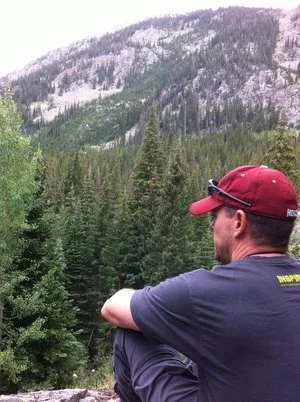
The third image takes a less subtle approach.
Here, I intentionally made myself obvious within the frame. The goal is still scale, but this time there’s no visual scavenger hunt involved. The viewer immediately understands the relationship between the person and the landscape.
Sometimes that clarity matters.
Massive scenery can lose its impact in a photograph because cameras flatten reality. Standing inside the frame helps restore some of that lost grandeur. It reminds viewers that these places are real, physical, and enormous.
It also introduces something emotionally relatable.
People naturally connect to people. Even a small silhouette can create a sense of adventure, solitude, vulnerability, or exploration.
A landscape without a person can feel endless. A landscape with a person can feel experienced.

Me and my buddy the King Of Wings
Image Four: The Hollywood Trick
The fourth image flips the entire concept on its head.
Instead of helping explain scale, the person exists to confuse it.
This is the same visual trick Hollywood often uses to manipulate perception. By carefully controlling perspective and subject placement, scale becomes uncertain. Large objects can appear tiny. Tiny objects can appear enormous. The viewer starts questioning what they’re actually seeing.
At that point, the subject of the image almost becomes scale itself.
The viewer pauses and studies the frame longer because their brain is trying to solve the puzzle. They’re no longer just looking at scenery. They’re analyzing relationships between objects, perspective, distance, and proportion.
Photography becomes less about documentation and more about perception.
And honestly, that’s part of what makes landscape photography so fascinating to me.
A camera doesn’t simply record reality.
It interprets it.