
Make Better Decisions With Less Stress: Meet the OODA Loop
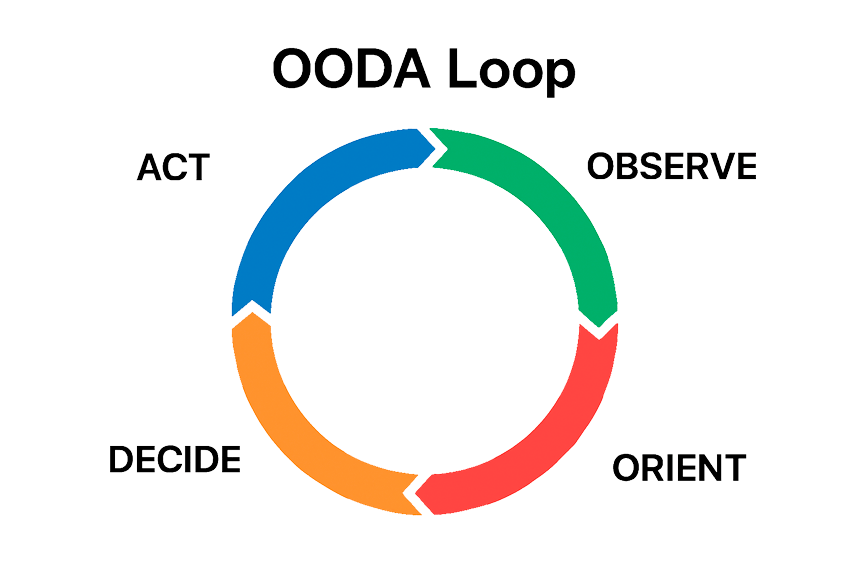
The OODA Loop
Using the OODA Loop to Stay on Track With Your Goals
In my recent Bottom Line Up Front (BLUF) post, entitled Turn The Mountain Into A Molehill, I talked about reducing large, intimidating goals into small, more manageable tasks. That approach helps you start moving instead of freezing under the weight of the big picture. But once you’re in motion, there’s another challenge: staying on the right track without drifting, stalling, or pushing forward blindly.
That’s where the OODA Loop, a decision-making framework developed by fighter pilot Col. John Boyd, comes in. While it was designed for high-stakes, fast-changing situations, it’s just as effective for everyday goal-setting and self-evaluation. It helps you check your direction, adjust quickly, and keep making meaningful progress.
Here’s how each step applies directly to the goal process described in the Molehill post:
1. Observe
This is your data-gathering phase.
In the context of your goal, observation means:
Noticing where you are or how your last step went
Paying attention to wins, setbacks, confusion, or friction
Checking whether the small task you’re working on is actually moving you toward the big goal
Assessing external factors (time available, energy, obstacles, resources)
Observation helps you avoid working on autopilot. Instead of bulldozing forward, you pause long enough to see what’s really happening.
2. Orient
Orientation is where you interpret what you observed.
Ask yourself:
What does the information I gathered actually mean?
Does it confirm I’m on the right path, or does it show I need a slight course correction?
Are my assumptions still valid? Do I need to rethink anything?
This is also the moment where your experience, knowledge, and context influence how you understand the situation. Orientation connects the dots and gives clarity before you take the next step.
3. Decide
Now that you understand the situation, choose your next action.
In your goal-setting process, this might look like:
Continuing with the next small task you originally planned
Adjusting the next step based on what you learned
Removing a task that no longer matters
Adding a small task you didn’t realize you needed
Decision is about picking one simple, actionable move, not reconsidering the whole goal.
4. Act
This is where momentum returns.
You carry out the decision you just made. No overthinking, no self-doubt. You execute, then cycle back to Observe.
The power isn’t in the action itself but in the fact that action feeds new information back into the loop, allowing you to make smarter and more precise decisions each time.
Loop the Process
The OODA Loop isn’t a one-time sequence. It’s a gentle, continuous feedback cycle.
Every time you complete a small step toward your goal, run the loop again:
Observe how it went
Orient your understanding
Decide your next move
Act
Repeat
This keeps you from drifting off-course and helps you adapt quickly instead of waiting until you’re far off track to correct yourself.
Once the decision is made, execution matters. Turning a complex goal into something actionable is often the hardest part—this is where the Molehill Method helps by stripping the goal down to a single, manageable step.
Why the OODA Loop Works So Well With the Molehill Method
It pairs perfectly with breaking big goals into small tasks
It builds awareness, which reduces overwhelm
It replaces guesswork with intentional action
It creates steadiness: small step → reflection → next step
It helps you pivot early instead of backtracking later
It turns progress into a rhythm rather than a struggle
The OODA Loop ensures that even when you’re working on your goal one bite-sized task at a time, you’re doing so with direction, clarity, and constant course correction, just enough structure to keep you moving while staying adaptable.
Related Posts: OODA Loop (you are here) → Molehill Method → OODA-Molehill Combined