
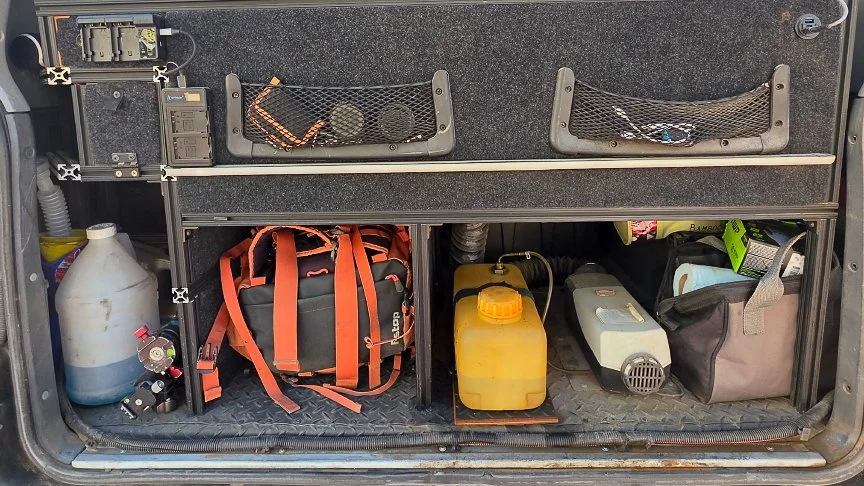
It may not be the prettiest installation, but it wasn't designed to be. It was designed to be compact, functional, accessible, and capable of keeping me warm during my year-round photography adventures.
Living in Colorado, one might assume that installing a diesel heater in a camper van is primarily about winter camping. While that certainly played a role in my decision, some of the mornings I've appreciated having a heater have been in the middle of summer!
Spend enough time camping in the Colorado mountains, particularly at higher elevations, and you'll quickly understand why.
As a landscape photographer, I'm often crawling out of my sleeping bag well before the sun makes its appearance. Having the ability to warm up the interior of the Five Billion Star Hotel while getting dressed and preparing for a morning of photography is a luxury I've grown quite fond of.
Like most modifications to my 1994 Mitsubishi Delica L300, this one required a bit of planning, a little engineering, and the willingness to drill yet another hole in my Delica.
Choosing a Diesel Heater
There are several options available when it comes to heating the interior of a camper van. For me, diesel made the most sense.
The Five Billion Star Hotel already runs on diesel. Why introduce another fuel source if I didn't have to? I wasn't particularly interested in carrying an external propane tank or plumbing a propane system into the Delica.
Ideally, I wanted to tap directly into the Delica's existing diesel fuel tank. Doing so would allow me to fill both the vehicle and the heater's fuel supply simultaneously.
However, I wasn't quite brave enough to tackle that portion of the project just yet. More on that later.
I purchased a relatively inexpensive Chinese-made Wayska 2kW diesel heater. If you're considering installing a diesel heater in a Delica L300, my recommendation, based on my experience, would be to resist the temptation to purchase anything larger.
The interior of a Delica isn't particularly large, and I've found the 2kW heater to be more than adequate, even when outside temperatures have dropped to −20°F.
Bigger isn't always better.
Planning the Installation
The eventual location of the diesel heater was something I considered while designing and constructing the interior of the Five Billion Star Hotel.
I reserved an area underneath the rear portion of my bed and storage compartment for the heater. This location provided access through the rear hatch, room for the necessary ducting, and access to the underside of the Delica for the combustion air intake, combustion exhaust, fuel pump, and fuel filter.
Having already built the floor and much of the interior furniture, there was one particular part of the installation I wasn't looking forward to.
Drilling a 5-inch hole through my floor!
Another Hole in the Delica
I don't particularly enjoy drilling holes in the Five Billion Star Hotel. In fact, I go out of my way to avoid doing so whenever possible.
Apparently, installing a diesel heater wasn't going to be one of those occasions.
Before drilling, I had to ensure that the proposed location provided sufficient clearance underneath the vehicle and that I wouldn't inadvertently drill into something that I'd rather not replace.
Once satisfied with the location, it was time to break out the hole saw.
Gulp!
Drilling a five-inch opening through the Delica's multilayered flooring and metal body to accommodate the diesel heater mounting assembly. This was definitely one of those "no turning back" moments!
One interesting byproduct of drilling this hole was that I ended up with a rather nice cross-section of the flooring system I had previously installed.
The removed section illustrates the various layers between the finished interior flooring and the original metal floor of the Delica.
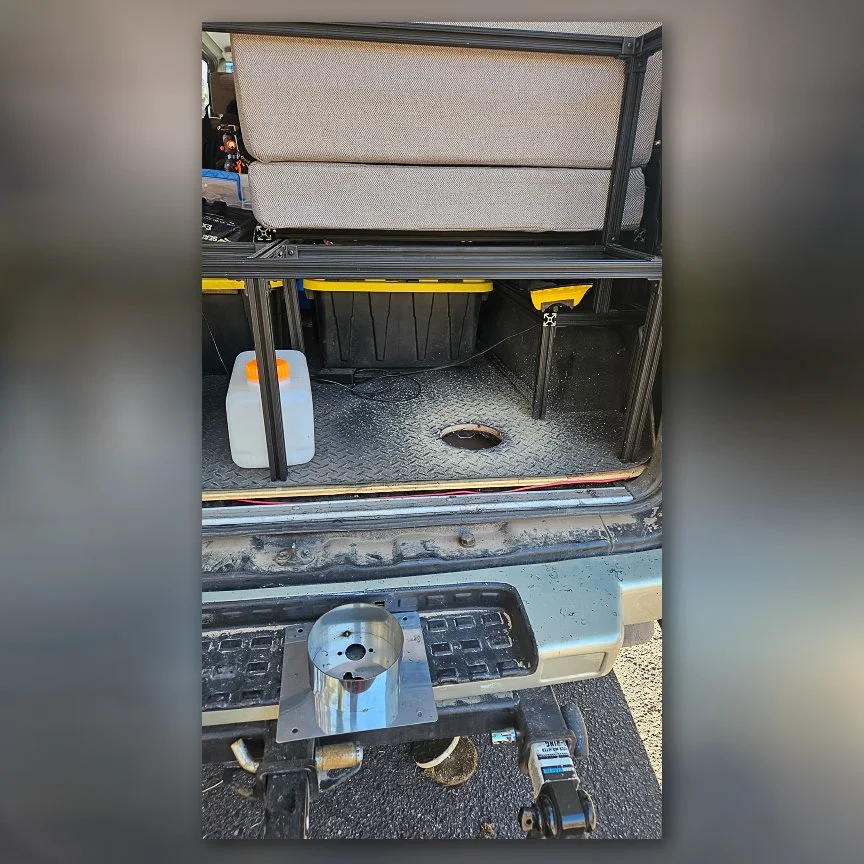
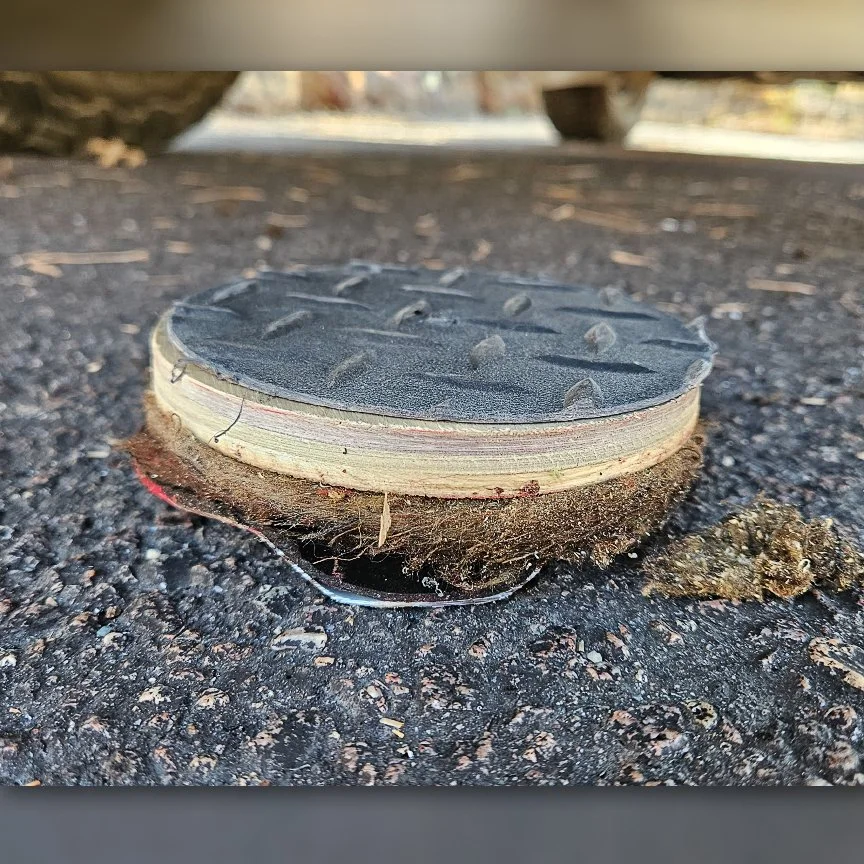
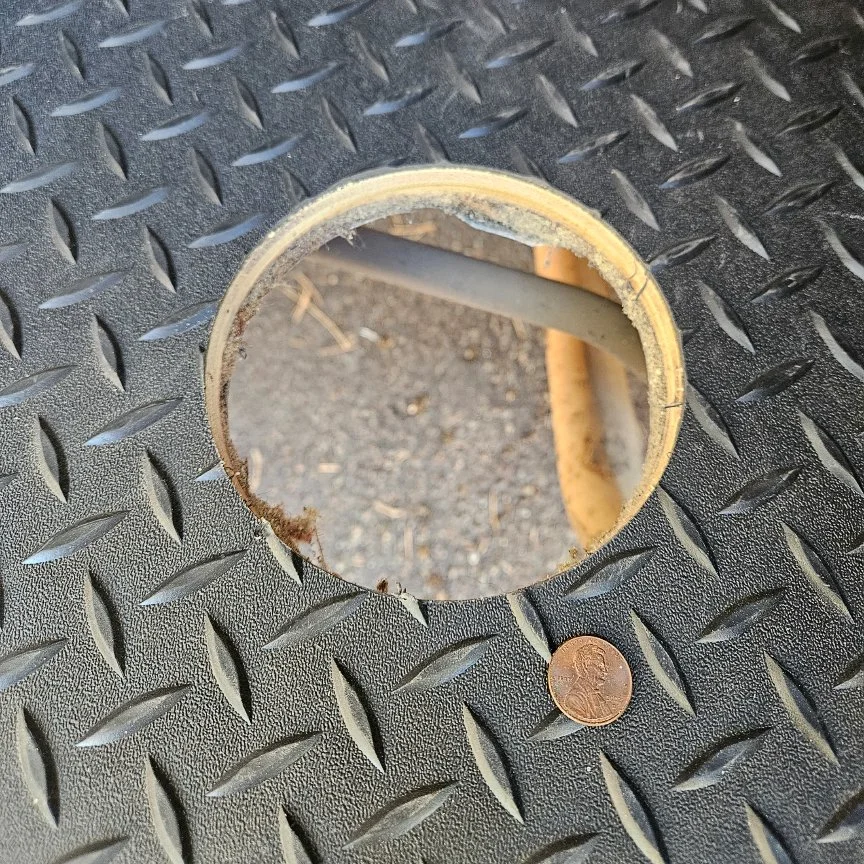
The point of no return! One unexpected benefit of drilling a five-inch hole in the Five Billion Star Hotel was getting a rather unique look at the layers of my custom flooring system.
Not exactly the method I'd recommend for obtaining a sample of your flooring, but there it was!
Installing the Heater Mounting Plate
Because of the thickness of my completed flooring system, I used a raised metal mounting assembly to accommodate the heater's connections through the floor.
This required a bit of preparation before the mounting plate could be secured in place.
The mounting assembly provides a passage through the floor for the combustion air intake, combustion exhaust, and fuel supply connections.
Preparing, modifying, and installing the diesel heater mounting assembly. An additional opening was required to accommodate the fuel pump wiring, which the purchased mounting assembly was not designed to accommodate.
I purchased a mounting assembly specifically for this installation. It allowed me to pass the heater's combustion intake, exhaust, and fuel supply through the various layers of my flooring. However, it did not accommodate the wiring for the fuel pump, so I had to cut an additional opening in the assembly.
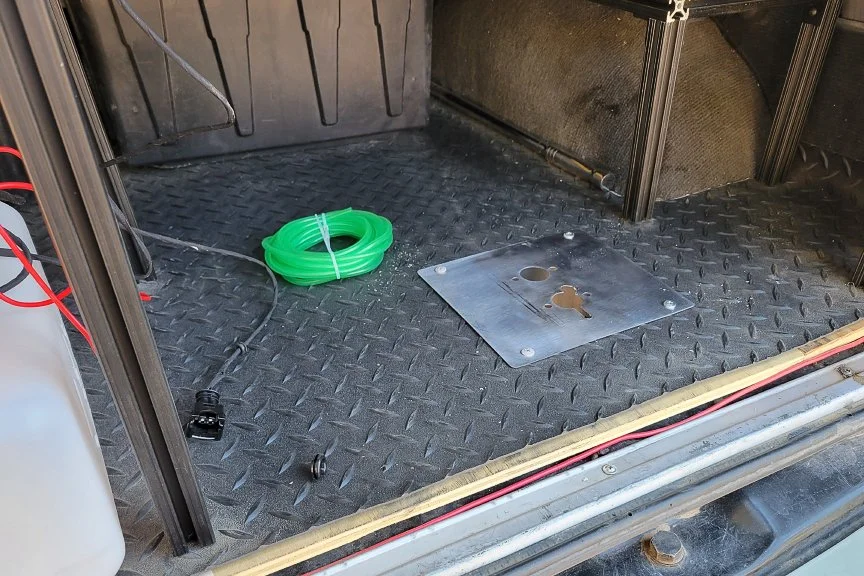
The completed mounting assembly provides a passage through the Delica's multilayered flooring for the combustion air intake, combustion exhaust, fuel line, and fuel pump wiring.
With the mounting plate in place, I could begin preparing the heater itself for installation.
Two Independent Air Systems
Before going much further, it's worth explaining an important distinction about diesel heaters of this type.
There are essentially two independent airflow systems operating within the heater.
The first is the combustion air system. Outside air is drawn into the heater, used during the combustion of diesel fuel, and exhausted back outside the vehicle.
The second is the cabin air system. Air from inside the Delica is drawn into the heater, warmed through a heat exchanger, and returned to the interior.
These two air systems are intended to remain separate.
For my installation, both the combustion air intake and combustion exhaust are located underneath the Delica. The cabin air intake is located on the heater itself, while the heated cabin air is routed through ducting incorporated into my interior furniture.
Preparing the Wayska 2kW diesel heater, making the necessary connections, and positioning it on the mounting assembly beneath the Delica's rear bed and storage compartment.
Routing the Combustion Exhaust
The heater came with a small exhaust muffler and flexible metal exhaust tubing.
During the original installation, I routed the heater's combustion exhaust underneath the Delica, near the vehicle's existing exhaust system.
At the time, I secured the two mufflers together using metal zip ties, with fiberglass furnace wrap separating and surrounding the areas where they were in contact.
The original installation of the diesel heater's combustion exhaust tubing and muffler underneath the Delica. Although the vehicle's engine exhaust system has since been modified to a side-exit configuration, the diesel heater's exhaust muffler remains in approximately the same location.
Since completing this project, I've modified the Delica's exhaust system to exit out the side of the vehicle.
As a result, the diesel heater's exhaust is no longer secured to the Delica's muffler. Its general location, however, remains unchanged.
The original installation footage reflects the configuration at the time of installation rather than its current configuration.
Fuel Pump, Fuel Filter, and Combustion Air Intake
The area above the Delica's original spare tire mounting location provided a convenient location for several components of the diesel heater installation.
I had noticed that this area remained relatively clean despite my travels on dusty trails and rough roads. It seemed like a sensible location for the filtered combustion air intake.
I also mounted the fuel pump and inline fuel filter in this general area.
Even with a spare tire installed underneath the Delica, the fuel pump and fuel filter remain accessible.
Before purchasing the heater, I had read numerous complaints about the ticking noise generated by these little diesel fuel pumps.
Some of those reviews must have been written by the princess from The Princess and the Pea!
I did install the fuel pump using the rubberized mounting sleeve supplied with it, in an effort to reduce the transmission of vibration and noise into the vehicle.
Perhaps that helped. Regardless, the ticking noise is barely noticeable from inside the Five Billion Star Hotel.
The combustion air intake isn't something I can hear, either.
Installing the diesel heater's fuel pump, inline fuel filter, and filtered combustion air intake underneath the Delica. The selected mounting locations take advantage of the available space around the spare tire while maintaining accessibility to the fuel system components for future maintenance.
Engineering a Slide-Out Diesel Fuel Tank
As I mentioned earlier, my original intention was to supply the diesel heater directly from the Delica's fuel tank.
However, I decided to leave that portion of the project for another day.
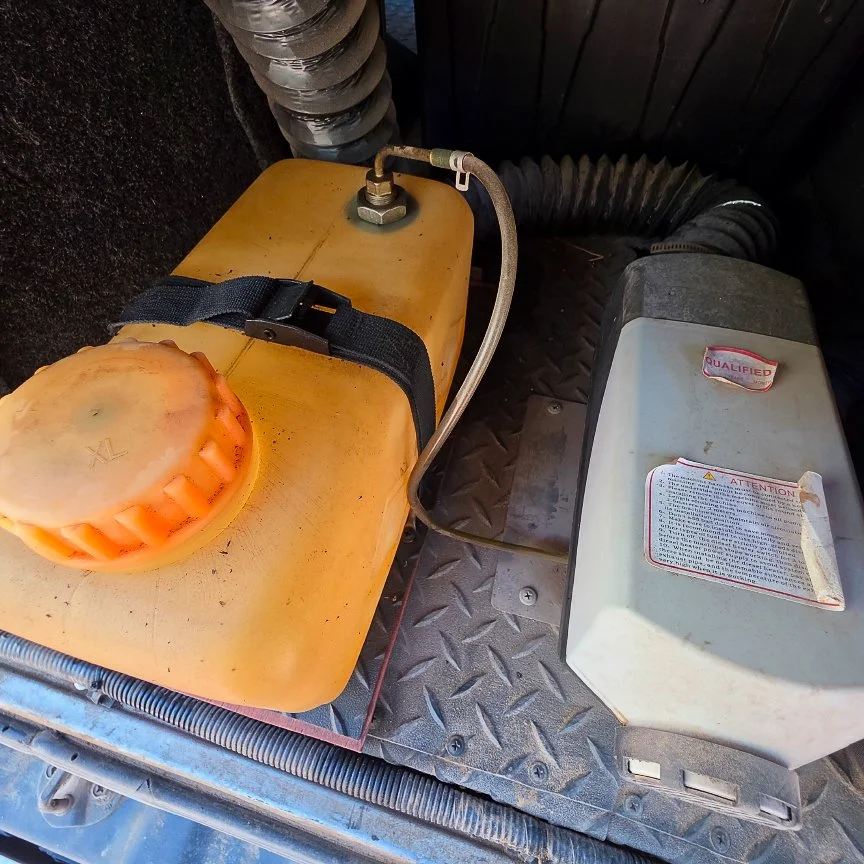
The heater came with a fuel tank, but I purchased a different 5.5-liter tank that better accommodated the installation I had envisioned.
One of my initial concerns was whether the 5.5-liter fuel tank would provide enough fuel for my adventures. As it turns out, I was worried about nothing. In all the time I've had the heater installed, I've only had to add fuel twice, and I use the heater quite a bit. What was once a concern isn't something I even think about anymore.
One thing I didn't want to do was bring a diesel fuel nozzle inside the Five Billion Star Hotel every time I needed to refill the heater's fuel tank.
My solution was to create a slide-out fuel tank.
The design is relatively simple. The tank is strapped to a board mounted on a drawer slide. I covered the board with the same material used for the interior flooring.
When it's time to refill the tank, I can open the rear hatch, slide the tank outward, and fill it without bringing the fuel nozzle inside the Delica.
Once filled, the tank slides back into its designated storage location.
Preparing the independent 5.5-liter diesel fuel tank and demonstrating the custom slide-out arrangement. The sliding platform allows me to refuel the heater's tank outside the Delica without disconnecting the fuel line or bringing a fuel nozzle inside the living area.
The system functions as intended. However, after spending considerable time traveling on rough roads, I've discovered one minor annoyance.
The fuel cap occasionally loosens just enough to allow a small amount of diesel to seep out.
While the amount has been small, fuel seepage inside a camper isn't something I want to accept as normal.
It has also given me another reason to revisit my original plan of tapping into the Delica's fuel tank.
Not only would doing so eliminate the need for a separate fuel tank, but it would also allow me to reclaim some valuable interior storage space.
And anyone who has built out a Delica knows just how valuable that space can be!
Distributing the Heat
Rather than simply allowing the diesel heater to discharge heated air into the storage compartment, I incorporated the heated air distribution system into the design of the Delica's interior furniture.
Flexible ducting routes the heated air from the heater below to two outlets mounted along the top of the rear storage compartment, which I refer to as the rear deck. This allows the heated air to be directed into the living and sleeping area without sacrificing additional usable space.
The heater draws cabin air directly into the unit, heats it, and returns it to the cabin through these two outlets. This air is entirely separate from the heater's combustion intake and exhaust, both of which are routed outside the Delica.
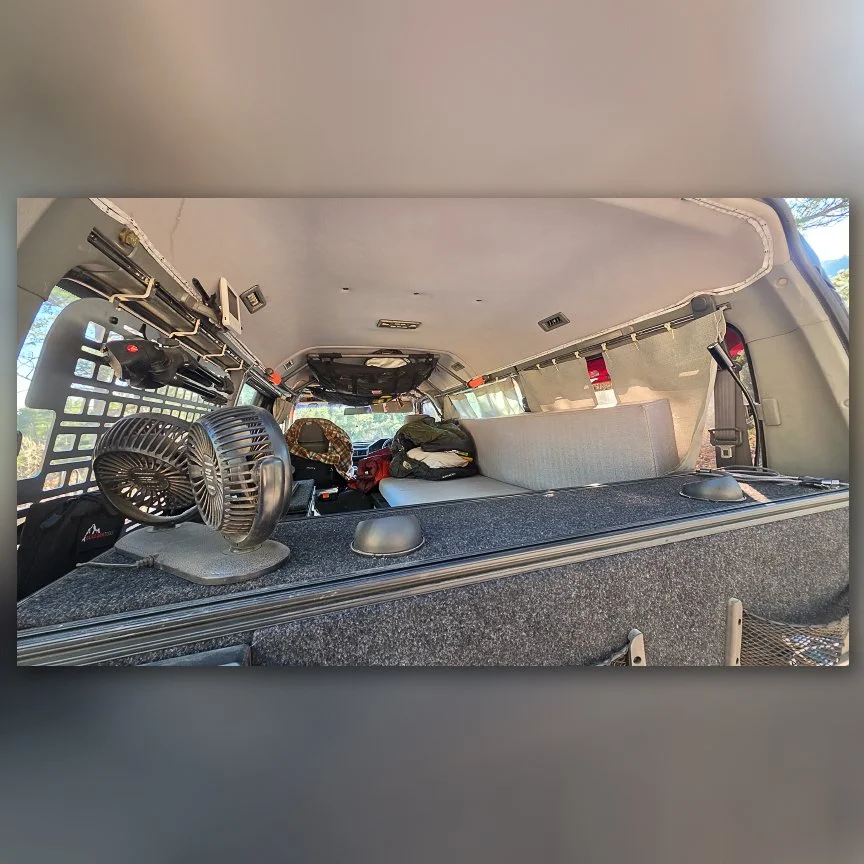
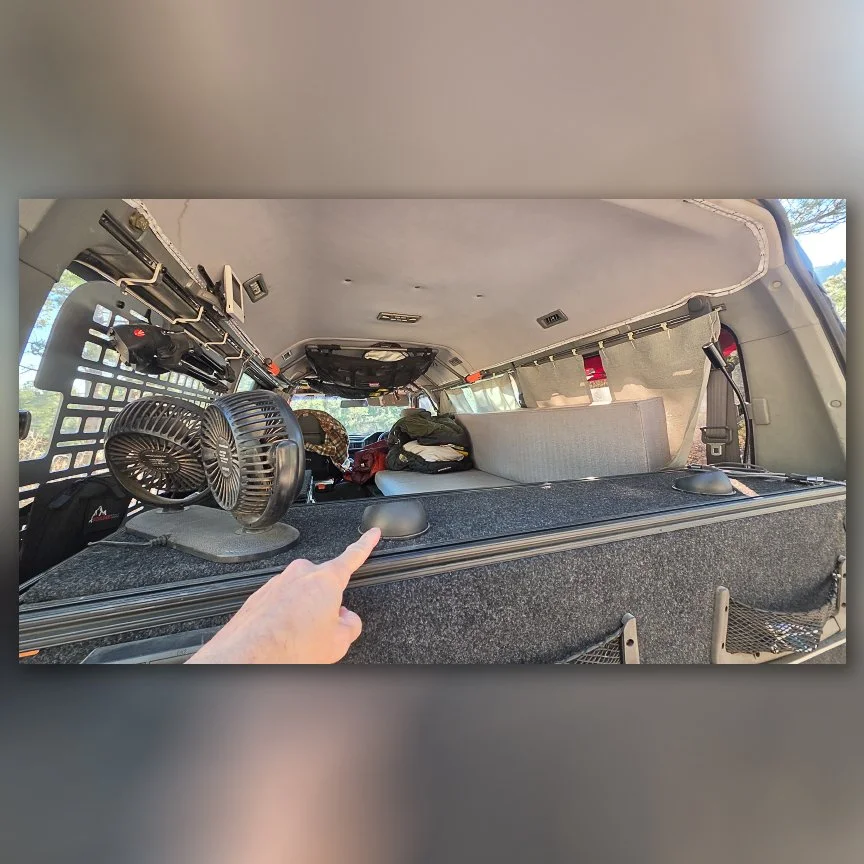
Flexible ducting routes heated air from the diesel heater beneath the rear storage deck to two integrated outlets above. Nearby three-speed auxiliary fans help distribute warm air throughout the Delica’s living and sleeping area, providing ample circulation even on their lowest setting.
The amount of air being circulated varies with the heater's fan speed, which adjusts according to temperature demand. Once the interior reaches the desired temperature, the heater throttles down and becomes considerably less noticeable.
An added benefit comes from the two auxiliary fans mounted on the rear deck. While they work great during the summer months, they really pay off during the winter. Their proximity to the heater outlets allows them to help circulate the heated air throughout the Delica, rather than relying solely on the heater's internal fan.
The fans have three speed settings: low, medium, and high. I've never found it necessary to run them on anything other than low.
It's another example of how something that serves one purpose during the summer can serve an entirely different purpose during the winter. When you live out of a vehicle as small as the Five Billion Star Hotel, I appreciate anything that can pull double duty.
The heater's controller is mounted on the front edge of my desktop area, perpendicular to the desktop itself.
There was a reason for choosing this particular location.
I wanted to be able to operate the heater from the bed without having to crawl out of my sleeping bag.
On those particularly cold Colorado mornings, that little design consideration is greatly appreciated!
The heater also came with a remote control, which I keep on my key ring. The controller has thermostat functionality and Bluetooth capability, although I've never really had a need to use the Bluetooth feature.
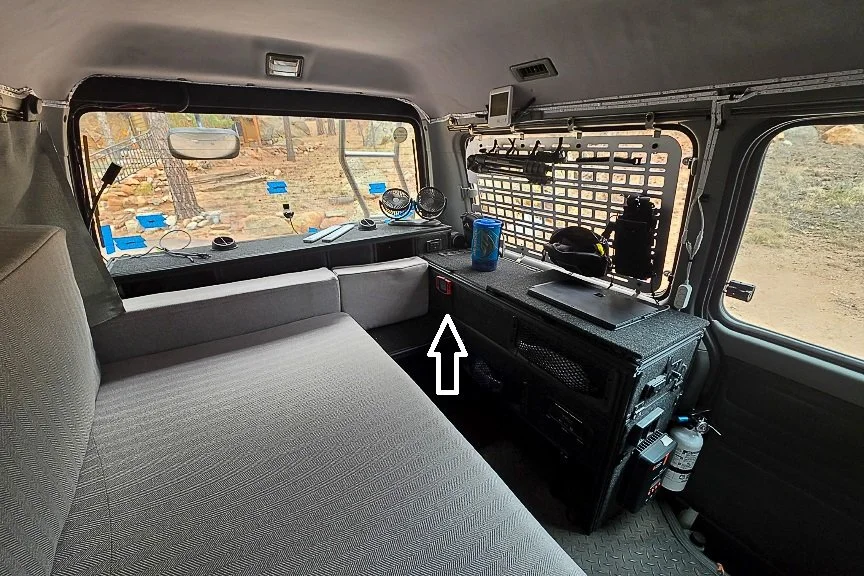
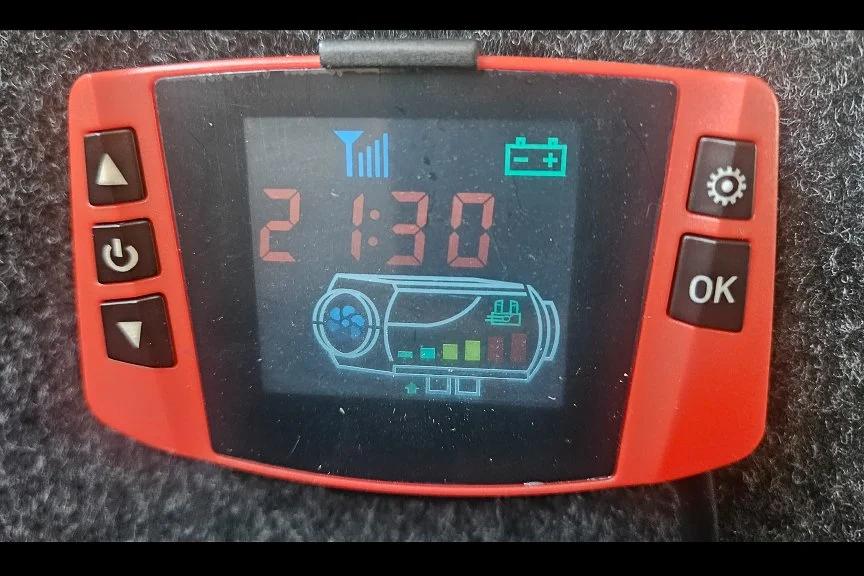
The Wayska 2kW diesel heater controller is mounted vertically along the front edge of the desktop, within easy reach of the sleeping area. This location allows me to turn on the heater and adjust the temperature without ever having to leave the warmth of my sleeping bag.
Powering the Diesel Heater
Like most of the equipment associated with the living quarters of the Five Billion Star Hotel, the diesel heater is powered by my house battery rather than the Delica's cranking battery.
I want the ability to heat the interior without worrying about whether I'll be able to start the Delica afterward.
The heater draws considerably more electrical power during its startup cycle than it does during normal operation.
Once running, its electrical demands are relatively modest.
As with other diesel heaters, power must remain available throughout the shutdown and cool-down cycle.
My house power system can be replenished by either the roof-mounted solar panels or the Delica's alternator via my DC-DC charger.
Living With the Diesel Heater
Installing a piece of equipment is one thing. Living with it is another.
I've now had the opportunity to use this heater throughout the year, at various elevations, and in temperatures as low as −20°F.
For the most part, it simply works.
Prior to purchasing the heater, I had read about some of the difficulties these inexpensive diesel heaters can experience at higher elevations. Naturally, living and traveling throughout Colorado, this was a concern of mine.
I've since used mine at an elevation of 13,000 feet. It took three attempts to get it started, but once it was running, it performed just fine. Considering what I paid for the heater, I really can't complain.
As for noise, you can certainly hear the heater running. However, it isn't so loud that you have to raise your voice to carry on a conversation.
Once the interior reaches the desired temperature, the heater throttles down, and the noise becomes even less noticeable.
Interestingly enough, I rarely run the heater throughout the night.
I typically use it for a while in the evening, perhaps while eating dinner, and then allow the interior of the Delica to cool down before crawling into my sleeping bag.
Unless it's exceptionally cold outside, I'm perfectly content to let the sleeping bag do its job.
The mornings are a different story.
Being able to reach over from inside my sleeping bag, turn on the heater, and wait for the interior to warm up before getting dressed is one of those little luxuries that makes life on the road considerably more enjoyable.
A Note About Safety
Any installation involving combustion inside a camper van deserves careful attention.
The combustion air intake and combustion exhaust must remain separate from the cabin air system, and the exhaust must be routed so that combustion gases cannot enter the living space.
Proper sealing, heat clearances, fuel system integrity, and adherence to the heater manufacturer's installation requirements are important considerations.
I also have a carbon monoxide detector installed inside the Five Billion Star Hotel.
This blog documents my particular installation and experiences rather than serving as a universal installation manual.
Would I Do Anything Differently?
With the exception of how I currently supply diesel to the heater, there really isn't much about this project that I'd change.
The 2kW heater has proven to be an appropriate size for my needs. The location works well, the heated air distribution works as intended, and the controller is conveniently accessible from the bed.
The fuel pump noise that I was initially concerned about turned out to be a nonissue.
My next step will likely be to revisit the idea of drawing fuel directly from the Delica's diesel tank.
Until then, the Five Billion Star Hotel has a reliable source of heat for those cold mornings in the mountains.
Who says a hotel with five billion stars can't have central heating?
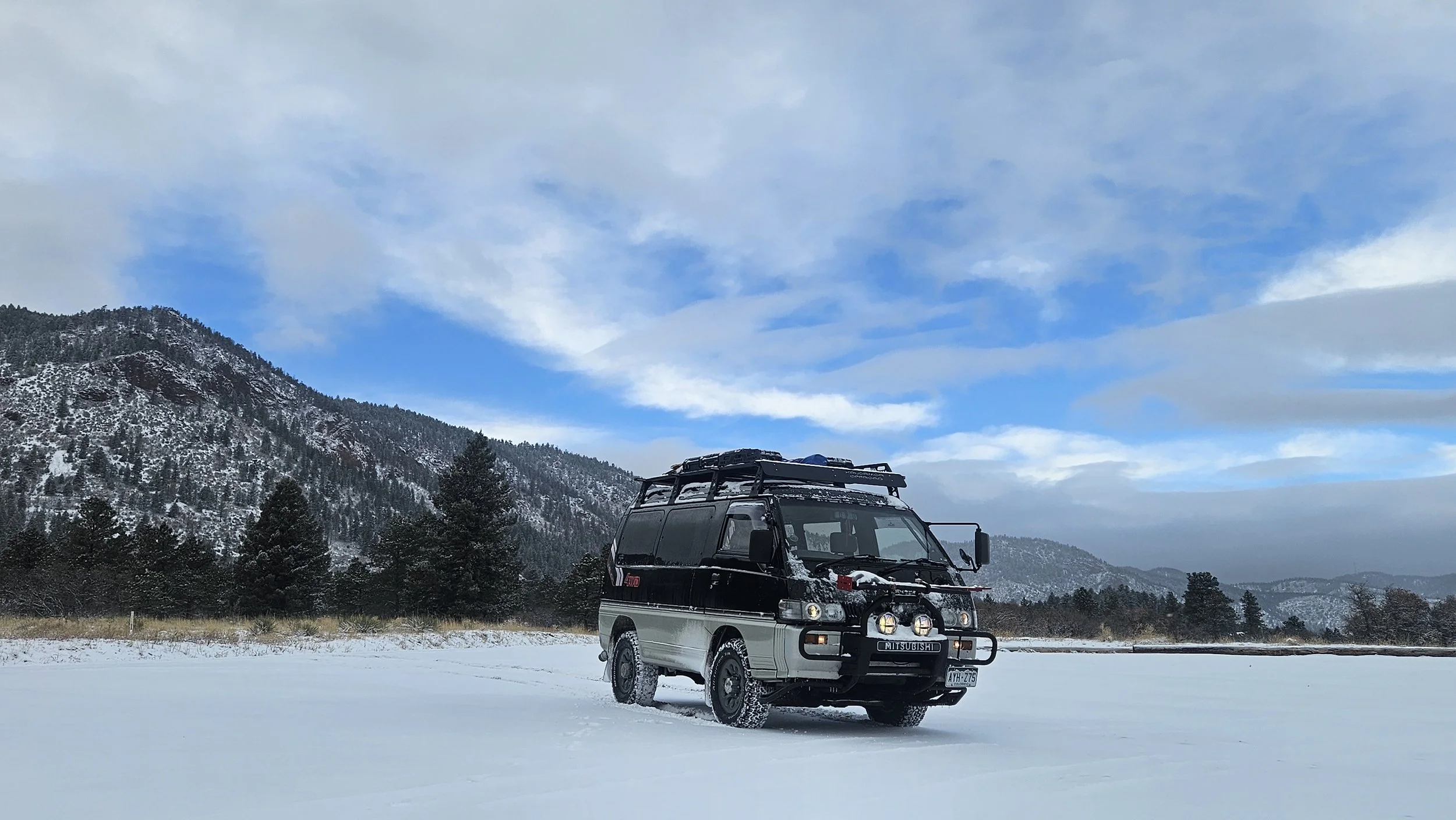
Winter adventures are considerably more comfortable with a reliable source of heat. The Wayska 2kW diesel heater has become one of my most appreciated additions to the Five Billion Star Hotel, particularly on those bitterly cold mountain mornings.