Half-Day Landscape Photography Training
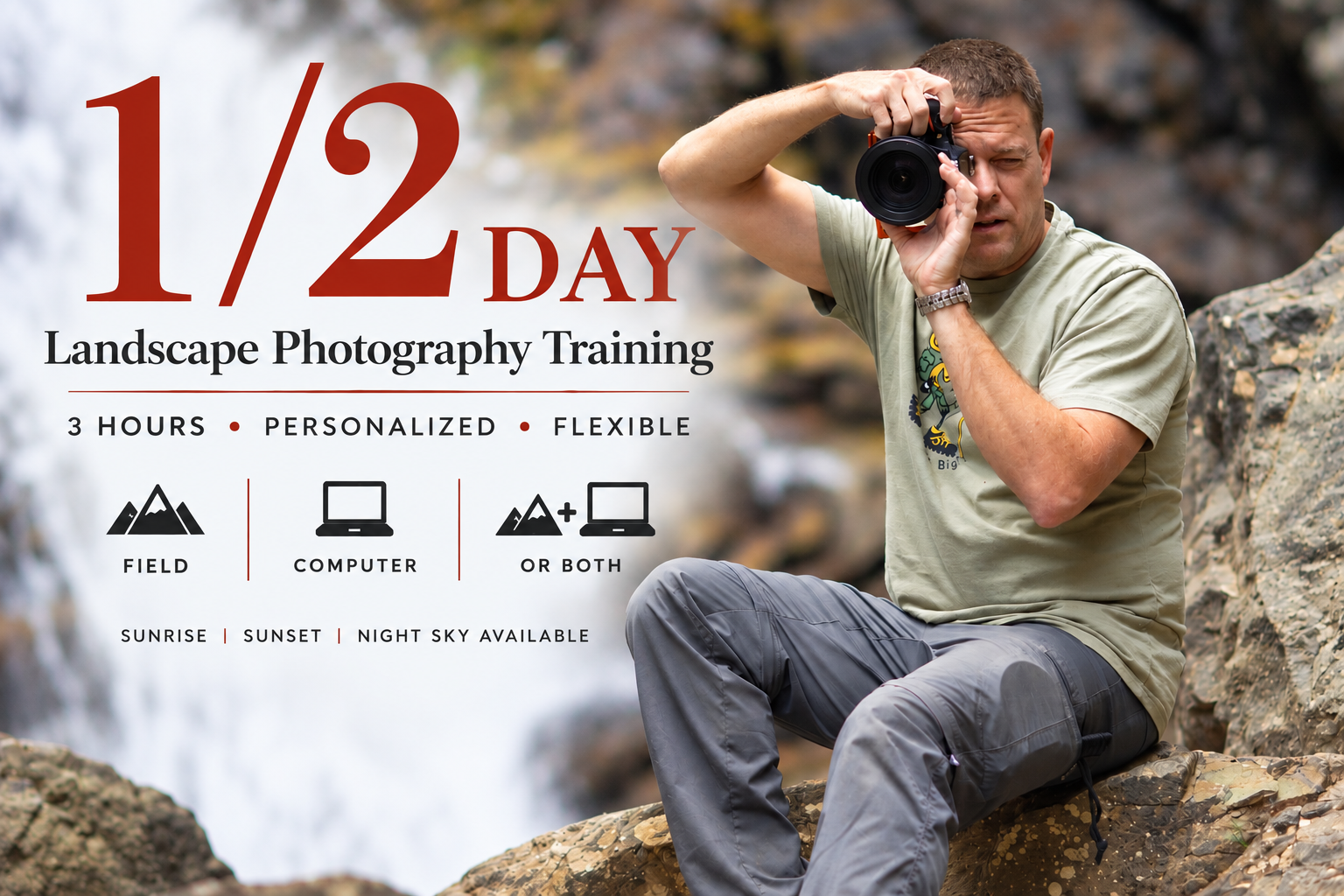
Three hours. One realistic goal.
A Half-Day Landscape Photography Training session gives us three hours to concentrate on what you want to learn.
That could mean understanding your camera, improving your compositions, learning to photograph a panorama, working through focus stacking, planning a sunrise, understanding your histogram, learning Photoshop, or figuring out why your photographs aren't turning out the way you want them to.
It could also mean grabbing our cameras and spending three hours walking through Garden of the Gods, making photographs and talking photography.
There isn't a predetermined lesson plan.
We start with what you know, decide where you want to go next, and use our three hours getting you closer to it.
What Can We Accomplish in Three Hours?
Quite a bit.
But probably not everything.
One of the easiest mistakes to make when booking photography training is trying to fit too much into a single session. Photography is full of subjects that initially sound simple but become considerably deeper once we start working through them.
Take panoramas.
We could discuss when a panorama makes sense, composition, camera orientation, exposure, focus, overlap, tripod technique, and how to capture the individual frames. Then we still need to take those photographs to the computer, stitch them together, deal with any problems, and finish the image.
Three hours can disappear pretty quickly.
That's not a problem.
Understanding one thing well enough to continue practicing it on your own is more valuable than rushing through five things you barely understand.
Half-Day Training Works Best When It's Targeted
If you already know what you'd like to work on, a Half-Day session may be all you need.
We could concentrate on:
Composition and seeing potential photographs
Exposure Triangle and camera settings
Histograms, RGB channels, and ETTR
Planning a landscape photograph
Working with changing light
Panoramas
Focus stacking
Long exposures
Sunrise or sunset photography
Night sky and Milky Way photography
Lightroom organization
Adobe Camera Raw
Photoshop
Layers and masks
Blending and selections
That's not a checklist for one session.
It's a list of possibilities.
Pick something that matters to you and we'll start there.
What If I Don't Know What I Need?
That's okay too.
You don't have to diagnose the problem before you book training.
Maybe you understand your camera settings but don't like your photographs.
Bring your camera. Bring some photographs. Tell me what's bothering you.
Maybe the problem is composition. Maybe it's timing or light. Maybe you're leaving information behind during capture. Maybe you're doing everything correctly in the field and getting stuck once you open the files at the computer.
Bring me the problem.
Part of my job is helping figure out where it actually begins.
Beginners Are Welcome
You don't need years of experience.
You don't even need a camera.
If you recently bought your first camera and have no idea where to begin, we can start there. If you're using a cell phone and want to better understand composition and light, that's fine too.
I've found that photographers sometimes want to jump ahead to a technique such as focus stacking before they're comfortable with exposure or composition.
I'll teach the technique.
But I may also point out the foundation underneath it.
Photography builds on itself. Sometimes the fastest way forward is figuring out which earlier piece is missing.
In the Field, On the Computer, or Both
A Half-Day session doesn't require you to choose one kind of training.
We can spend all three hours in the field.
We can spend all three hours on the computer.
Or we can combine the two.
For focus stacking, we might photograph the stack and then sit down with those files and assemble it. For a panorama, we could work through the capture and then stitch the resulting photographs. For exposure and ETTR, we can make the photographs and then open the RAW files to see exactly what information we captured.
You're booking three hours of personalized photography training, not a rigid curriculum.
We'll use those hours where they'll do you the most good.
Mother Nature Might Change the Lesson
If we're working outside, we should have a plan.
We should also be willing to change it.
Weather, clouds, light, wind, and conditions can change what we're able to photograph. Sometimes those changes create better opportunities than the one we originally planned.
If conditions no longer support what we're trying to learn, we can adapt. We might change locations, change subjects, or grab a cup of coffee and move the lesson to the computer.
Mother Nature gets a vote.
Learning to respond to what she gives us is part of landscape photography.
Where Does Half-Day Training Take Place?
I'm based in Monument, Colorado, and most Half-Day Training takes place around the Colorado Springs area.
The location depends primarily on what you want to learn.
Garden of the Gods might be perfect for one session. The Paint Mines might make sense for another. We could hike a trail at Mueller State Park, stay close to the road, meet at a coffee shop, or choose another location that better supports the lesson.
We'll also work within your physical abilities. You don't need to hike miles into the wilderness to learn landscape photography.
If you're in the Colorado Springs area, you can generally book any available Half-Day time that works for you. We can work out the location and specifics afterward.
If you're outside the Colorado Springs area, contact me before booking.
What If Three Hours Isn't Enough?
Sometimes it isn't.
That doesn't mean a Half-Day session failed.
If we discover that a subject is deeper than expected, I'd rather spend our time making sure you understand what we're doing than rush through the rest of it.
You may leave with enough knowledge to continue practicing on your own.
You may decide you'd like another Half-Day session to pick up where we left off.
Or, if you already know that you want more time to establish a foundation, practice what you're learning, evaluate the results, and refine the process, my Full-Day Landscape Photography Training gives us six hours to work together.
You don't eat an elephant in one bite.
Photography isn't any different.
A Few Things to Know
How long is a Half-Day session?
Three hours.
Can I book an early morning, sunrise, evening, or nighttime session?
Yes. My Half-Day booking calendar includes early and late options because the best landscape photography light doesn't always happen during business hours. Night sky training is also an option.
Do I need my own camera?
No. Bring what you have, even if that's only a phone. If you own a camera, tripod, filters, or other equipment you'd like to learn with, bring them.
Can someone come with me?
A non-photographing friend or family member is generally fine. If another photographer wants to participate in the training, contact me first. My booking system reserves the time slot once one photographer books, so an additional photographer has to be arranged separately.
Are entrance or parking fees included?
No. If you choose a location requiring an entrance, parking, permit, or similar fee, you're responsible for that cost.
Is transportation included?
No. We'll arrange where to meet, and you'll provide your own transportation.
What happens if the weather doesn't cooperate?
Bad weather can make great photographs, so clouds or rain don't automatically cancel a session. If conditions are unsafe or make our planned training impractical, I'll generally try to reschedule. If I can't make the session and rescheduling isn't practical, I'll offer a refund.
Three Hours. Where Do You Want to Start?
You don't have to learn everything today.
Set a realistic goal. Build the foundation. Understand what you're doing well enough to practice it after our session.
Then build from there.
The goal is simple:
Leave knowing more about the thing you came to learn than when you arrived.