
Recommendations: The Hidden Engine Behind Facebook Growth
Recommendations play a central role in the Audience, Reach, and Growth framework.
Most creators talk about followers.
Facebook cares about recommendations.
If you understand how recommendations work and how easily you can lose them, you gain access to the single most important growth engine on the platform.
Let’s break down what recommendations really are, why they matter, how creators lose them (often without realizing), and how to protect and rebuild them.
What Recommendations Really Mean
Recommendations are when Facebook pushes your content to people who do not follow you.
This is:
How strangers discover you
How videos go viral
How growth happens outside your existing circle
Without recommendations, you are only talking to people who already know you, which means growth eventually stalls.
This is why two pages with similar follower counts can perform wildly differently: One is being recommended.
The other is invisible to new audiences.
> Always check your recommendation status. Facebook does not always notify you when it changes.
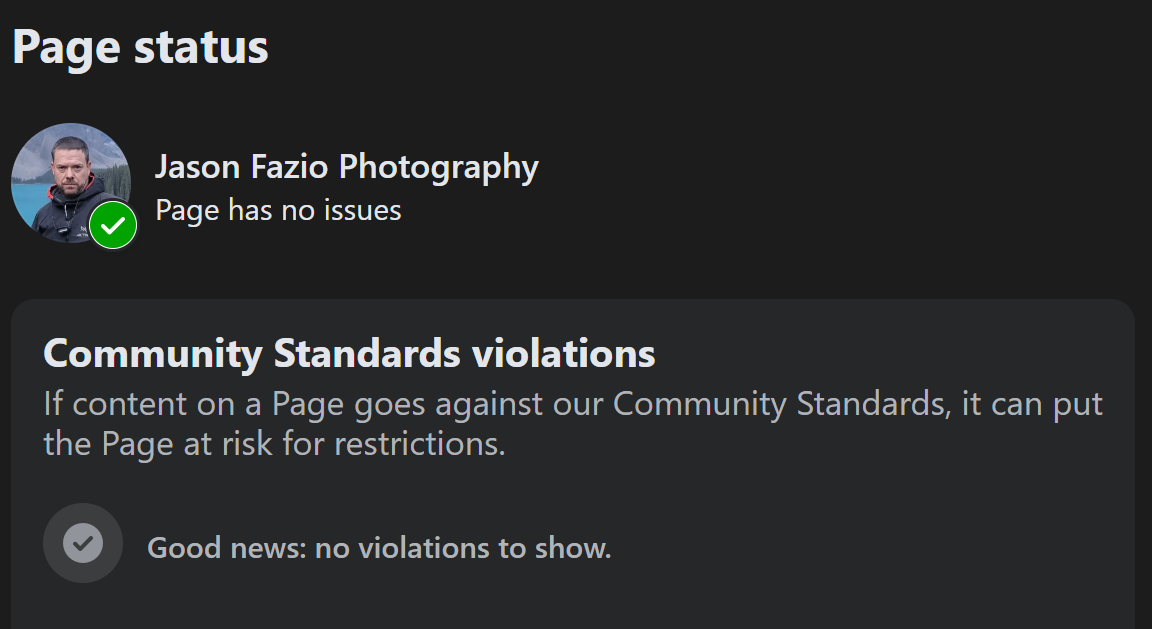
Jason Fazio Photography is recommended by Facebook.
Why Recommendations Are So Important
This is where real growth lives.
Most reach does not come from followers
Most monetized views come from non-followers
Facebook watches how new people react to your content
If strangers watch, engage, comment, save, and stay, Facebook pushes you more.
If strangers skip, ignore, or react negatively, distribution slows or stops.
Recommendations are Facebook’s way of testing your content with new people and rewarding you when it performs well.
How Creators Lose Recommendations
This often happens quietly and gradually.
Common causes include:
Content issues
Violations (misinformation, hate speech, spam, misleading or violent content)
Prohibited or restricted content that looks normal but falls into limited categories
Certain sensitive or prohibited words that quietly limit distribution
Adult content or adult-related interaction (viewing, sharing, commenting, Messenger reports)
Behavior issues
Spammy behavior (mass friend requests, mass DMs, sending links too often)
Getting reported in comments or Messenger
Heavy business promotion on a personal profile
Bad account history (previous restrictions, warnings, admin or page issues)
Growth manipulation
Buying followers or likes
Follow-for-follow engagement
Fake or automated activity
Content quality
Low watch time
Fast skips
Few meaningful comments or shares
No clear niche or topic
Reposting content without adding value
Using watermarked videos from other platforms
Begging for engagement (“Like, share, comment to support me”)
Facebook doesn’t always send alerts when recommendations are reduced, which is why creators often feel like “something broke” without knowing what.
Content structure influences recommendations, which is explored in Why We Stop Scrolling.
How to Fix and Protect Your Recommendations
Here’s what actually works:
Create original content only
Use strong hooks that stop the scroll
Make sure every post has clear value
Focus on one niche so the algorithm understands who your content is for
Prioritize watch time, saves, and real comments
Avoid spammy actions and forced engagement
Keep your account clean and compliant
Post consistently, not randomly
Be patient and let data guide decisions
Think long-term, not viral-chasing.
Why Copy-and-Paste Strategies Fail
Each account is evaluated differently.
What works for one creator might hurt another, depending on:
Account history
Audience behavior
Content category
Previous violations or reports
Messaging and interaction patterns
That’s why “just do what worked for me” advice often backfires.
Every account needs to be reviewed and optimized individually.
Final Thought
Followers are a vanity metric.
Recommendations are a growth system.
If you protect your recommendations, you protect your future reach, discovery, and income on the platform.
Treat them like the asset they are.
This article is part of Photographer’s Corner, a growing collection of essays on photography mindset, growth, storytelling, engagement, and sustainable creative business.